You put on orange glasses, open a sleep-tech shop, and read a promise: block blue light, sleep better. It sounds clean. Light biology is real — but a product claim and the strength of evidence are not the same thing.
This article is about claim literacy: what blue-blocking glasses do according to systematic reviews, what remains uncertain, and why dimming screens and changing evening behaviour often makes sense before a purchase. It is not a brand review. It is not a ban on glasses.
What “blue-light glasses” means
These lenses filter part of short-wavelength visible light (often labelled “blue”). Marketing may promise less digital eye strain, retinal protection, and better sleep. A Cochrane systematic review (2023) examined those areas in adults — and for sleep it landed cautiously: the evidence is unclear. (PubMed 37593770)
Important split: evening light (brightness + spectrum + timing) really affects alertness. That does not mean every filter in a frame reliably “fixes the night”.
What systematic reviews say (no invented miracles)
Cochrane 2023 (17 RCTs): authors did not meta-analyse sleep outcomes because of heterogeneity. For subjective sleep quality they report mixed results across trials and rate certainty as very low — the effect is indeterminate. Short-term, blue-filtering lenses may not reduce computer eye strain more than non-filtering lenses; for visual acuity there is probably little or no difference. (PubMed 37593770)
Shechter et al. (Sleep Advances) — meta-analysis of interventions reducing short-wavelength light before sleep (including tinted lenses): few studies (k = 12), inconsistent findings. Combined effects on some objective outcomes are small to medium, but for sleep efficiency the confidence interval includes zero. Authors describe some, albeit mixed, evidence — not a universal buy recommendation. (PubMed 37192881)
Lawrenson et al. 2017: few high-quality RCTs to that date; mixed sleep signals; overall lack of high-quality evidence for many marketed claims. (PubMed 29044670)
Plain summary: someone may subjectively benefit; the evidence base is not a consistent “yes, it works for everyone”.
A stronger lever than a frame
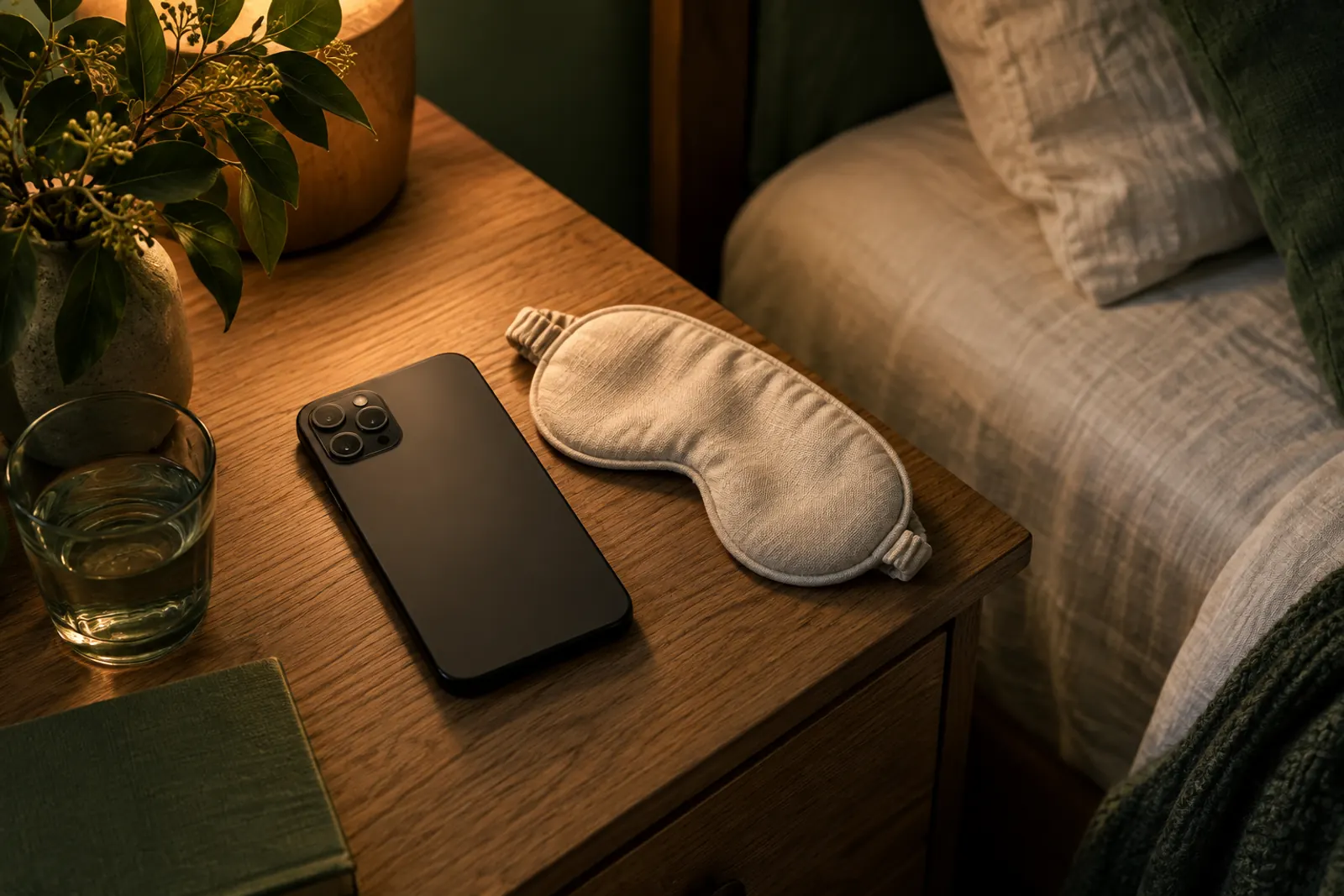
The American Academy of Sleep Medicine’s public messaging recommends avoiding blue light from handheld electronics 30–60 minutes before bed, powering devices down, and ideally keeping the phone out of the bedroom. The point is not “buy a filter”, but reduce evening light and arousing content that keep you alert. (AASM)
Practically:
- Lower brightness of screens and lights in the evening (often a bigger change than a mild spectral filter).
- Shorten the scroll — content keeps the brain up even without “blue”.
- More stable light timing — more daylight by day, less bright light at night.
Our phone-before-bed piece focuses on behaviour and attention; this one is about product myth versus light biology. They complement each other.
How to read product promises
- Prefer RCTs and systematic reviews, not only before/after testimonials.
- Separate wearing comfort from sleep claims.
- If you try glasses, treat it as a personal experiment alongside dimming — not as a substitute for a wind-down routine.
- Do not expect a medical miracle from a product page.
Adverse effects in reviews are infrequent, but studies mention discomfort, headache, or mood changes in some people — another reason not to idealise the product. (PubMed 37593770)
Takeaway
Blue-blocking glasses are not automatically a scam — nor a proven sleep drug in a frame. The fairest reading of the evidence: mixed to uncertain results, with more confidence in dimming evening brightness and turning screens off than in a universal shopping tip. If you experiment, experiment cheaply and measure your own night — not a marketing percentage.
Our sources
Research and further reading. Practical suggestions are editorial ideas, not a personalised treatment plan.
- Blue-light filtering spectacle lenses for visual performance, sleep, and macular health in adults
- Interventions to reduce short-wavelength ("blue") light exposure at night and their effects on sleep: A systematic review and meta-analysis
- The effect of blue-light blocking spectacle lenses on visual performance, macular health and the sleep-wake cycle: a systematic review
- Americans are ‘doomscrolling’ at bedtime, prioritizing screen time over sleep



